Sunday, October 08, 2006

Where Vultures Gather

As I was reading my Bible this morning a passage that has always baffled me suddenly became clear. As I explain it, perhaps you will say, "Well, of course! You never realized that before?"

Well, no, I never did, and because I think there may be others in my shoes, permit me to go through the passage (Matthew 24:24-28:

For false Christs and false prophets will appear and perform great signs and miracles to deceive even the elect - if that were possible.

So if anyone tells you, "There he is, out in the desert," do not go out; or, "here he is, in the inner rooms," do not believe it. For as lightning that comes from the east is visible even in the west, so will be the coming of the Son of Man. Wherever there is a carcass, there the vultures will gather.

It always seemed to me that the line about vultures (which I've italicized) was pretty mysterious. I didn't see what it had to do with the rest of what Jesus was talking about.

But now, I believe I finally see it.

The carcass is a false Christ (or false prophet) and the vultures are those who gather to feed on the rotting meat he has to offer. It is a commentary on both the false Christ (one who is spiritually dead and whose message is rotten like a decaying carcass) and those who gather around him (those who enjoy his dirty message, like vultures who enjoy the taste of rotting flesh.)

To carry it just a bit further, this may also be a contrast between the true Christ and false Christs. Jesus told his disciples that he is the "bread of life" (John 6:35) and that they were to eat his flesh and drink his blood (John 6:56). In the same sense, the followers of the false Christs eat of their master, except in their case it is not a meal of life, but of death.

Sunday, October 01, 2006

How to Get Rich

I was having lunch the other day in the patio of my company when an engineer walked up and asked if he could share my table since every other table was occupied.

Sure. No problem.

Well, we got talking of this and that and somehow the conversation led up to how he occasionally has lunch with other engineers and they discuss ideas that they think would be great products.

But, he said, the ideas are almost all rejected. Sooner or later someone will always say about the idea: "Nah, that would have to be sold."

I laughed at this illustration of engineers' stereotypical distaste for the kind of pushy social interaction involved with sales, but the thought occurred to me what a huge opportunity this could be for the sales person who would like to start his or her own company.

So here's the secret: Turn off your overbearing social charm and get to know the engineers at your company; the working ones right down at the bottom. Hang around with them; go to lunch, let them do most of the talking, listen to their ideas, and if you don't get it, ask them to explain what they mean. They're smart and generally nice people who, while they may not always suffer fools gladly and may not always express themselves tactfully, frequently enjoy explaining topics involving their expertise and are pleased when others are interested.

So, if my point isn't obvious yet, what I'm suggesting is that you and an engineer with a great idea might make an awesome team and might build a fine company that makes a great product.

By the way, did I mention that you need to turn off your overbearing social charm?

Saturday, September 30, 2006

Frankincense and Computers

I was reading the book of Revelation in the Bible this morning and came upon the passage about the destruction of Babylon (Rev. 18:11-13), which says "the merchants of the earth will weep and mourn over her" because nobody is buying their products, which include gold, silver, precious stones, pearls, linen, purple, silk and scarlet cloth, citron wood, articles of ivory, costly wood, bronze, iron, marble, plus cinnamon and spice, incense, myrrh, frankincense, wine, olive oil, flour, wheat, cattle, sheep, horses and carriages, and the "bodies and souls of men."

For a passage about a prophesy that hasn't yet come to pass, I thought that list of merchandise sounded rather outdated. What about automobiles and DVD players and computers and television sets and so forth? We have those things now, so presumably the people in the last days will also have those things, or some better equivalent. Didn't God know about modern inventions when this passage was written?

Yeah, sure he did! The problem was that my perspective - as I began thinking about it - was just too self-centered. The Bible was written not just for me but for people across a huge (in human terms) span of time, and the mention of television sets, for example, would be incomprehensible for people just decades ago, not to mention a thousand years ago.

But on the flip side, the mention of linen and olive oil and cattle and so forth is completely comprehensible to us, and while some of these products may be old fashioned to us, we still know what they are, and if we don't (what is citron wood, anyway?) well, we can look them up.

In other words, God made it so people in years past could understand this passage, and so people today and tomorrow can understand it.

Sunday, September 17, 2006

Downtown Los Angeles

I was called for jury duty last week and had to spend a couple days in downtown Los Angeles. During some of the breaks I wandered around town a bit and was reminded of why I almost never go into LA.

I don't mean to be harsh toward the city. It's a huge expanse and I know there are some lively and interesting areas of LA, but the Downtown (by which I mean the area in and around City Hall) is ratty and uninviting, though up the hill (on Hill Street) it is nice and uninviting. I mean, this is one of the most important cities in not just the United States, but in the world, and at its heart it is pretty much a disgrace.

If I may for a moment treat Downtown as a seperate entity from the rest of sprawling LA, I'd say it seems to be just a commuter zone. For example, I was looking for a place to have lunch and asked a woman on the street where I might find a restaurant.

"You like Mexican?" she asked.

"Sure," I said.

Well, she walked with me all the way to Olivera Street, about five blocks away. It was one of the few lively spots I found in the area, and the whole of Olivera Street is tiny, not to mention being quite a distance from all the big office buildings and across a grubby freeway overpass. (When I got back to the courtroom I heard another juror say that he went on what sounded like an even longer hike to find a restaurant.)

Anyway, as we were walking along this woman mentioned she lived in Corona.

Corona!? Ouch! What a nasty, long commute!

But that is the impression I got about the whole Downtown, that few if any of the office workers live nearby and that the place is probably pretty abandoned at night.

The area is covered with huge full-block buildings - mostly government - that you clearly don't go into unless you have business there. You can walk for long stretches and encounter no openings for people, just monolithic walls with the occasional vehicle service entrance and locked doorway decorated with yellowing sheets of newspaper. It seems that whatever life there is in Downtown is inside these huge buildings, but get out on the street and it's dead. Unless you're outside at the beginning or ending of the work day, or at noon, you can walk blocks and blocks and seldom pass more than a few people per block, most of them apparently homeless (and nothing against them; they provide what little life there is on the streets).

Don't get me wrong. Some of the buildings in the Downtown are beautiful (though others are gag ugly) with nice grass areas, and there are pretty parks - which appear generally abandoned, even at lunch time. So where are the people?

Well, one day at lunch I found quite a few of people - underground. There is a "mall" that is below ground level. It features a set of not-impressive-but-okay fast-food outlets, most of them apparently independent. The mall has a tiny sign at the top of the stairway going down, as if the city sort of reluctantly realizes that people need to eat but is embarassed that anything so crass as a commercial establishment should mar the solemn grandure of massed government buildings.

As I walked around Downtown I found weed and trash covered lots, places where it stinks (literally), blackened chewing gum spotting the sidewalks (all over), poor quality repairs that have been made to concrete sidewalks using asphalt, broken concrete that was unrepaired (even with asphalt), boarded up and run-down businesses. And yes, there are a few interesting spots (a seafood mall, for example), but the overall impression is one of sad, dirty dullness.

Someone will mention that if you go west a bit, up the hill, on the appropriately named Hill Street, there is where it becomes elegant. True, but it is a dreary sort of elegance. The Disney Concert Hall, the other concert facilities and the cathedral are attractive, but they are also just more block-square monoliths, though I did see some attractive condos or apartments being built (more on that in a moment).

One of the main points advanced by Jane Jacobs - a brilliant analyst of city life - is that what makes a big city lively and safe is mixed uses, which ensures there are always people on the streets, day and night. If you mix offices and stores and churches and residential and restaurants and movies and parks and other uses close together then you always have people coming and going, keeping an eye on the area and making it both safe and interesting.

And sadly, that is exactly what Downtown is not; even the new parts (at least those parts I saw). The area seems overplanned, as if the city said, "Let's clear off this whoooole block and put something really magnificent here!" And they do, and it's magnificent, and it's also lifeless.

These fine new buildings, that could contribute so much to the community, don't seem to do so because they don't have any other lively things going on around them. For example, I'd think that people who have just got out of a concert just might like to wander across the street and have a cup of coffee at a restaurant. Well, lotsa luck! From the looks of it, it's just drive in, drive out. A soulless commuterville.

In concluding I need to emphasize that I'm only speaking from my experience of a couple of days and I don't know the circumstances surrounding the development of Downtown LA, so take what I'm saying with a grain of salt. Also, just today I spoke with a friend who said the city of LA is trying to address exactly the problems I saw, so perhaps those condos or apartments I saw being built up on Hill Street are part of the solution. Well, good. If there are people working to fix this problem, blessings upon them! I wish the city well. One of the great cities of the world should have a far livelier downtown than it now has.

Saturday, September 16, 2006

God Hardening Hearts

It has always troubled me a bit where the Bible says in Romans 9:18 that God "hardens whom he wants to harden."

Why then, I ask - as Romans 9:19 asks - does "God still blame us? For who resists his will?"

Paul explains that the potter has the right to do with the clay whatever he wants, and that is certainly true. God is the potter and we are the clay, and I am able to accept that God is all-wise and if he hardens the hearts of some, well, I don't get it, but he knows best.

But in rereading Romans I noticed something else, something that had eluded me before.

A couple chapters further on, in Romans 11:25, it says that "Israel has experienced a hardening in part until the full number of Gentiles has come in. And so all Israel will be saved."

That "until" struck me. The hardening in the case of Israel was not permanent. It is only for a time, and then "all Israel will be saved."

I thought back to Romans 9 with this in mind, and wondered if the hardening spoken of there might also a temporary measure used by God for some specific purpose. And I wonder if it may be the case most of the time that there are times when God temporarily hardens the hearts of people, but then when his purpose is accomplished he removes that hardening to allow them to be receptive to his love.

Friday, September 08, 2006

Pick Your Battles

I've always regarded Paul, the author of a good chunk of the New Testament, as an uncompromising proclaimer of truth and opponent of error, but during a recent reading of the Book of Romans, rather to my surprise, I noticed an important caveat that hadn't sunk in before - that there are some errors that we shouldn't oppose.

The passage that hit me - if you care to follow along - is the fourteenth and fifteenth chapters of Romans, but specifically, Romans 14:14, where Paul writes: "As one who is in the Lord Jesus, I am fully convinced that no food is unclean in itself. But if anyone regards something as unclean, then for him it is unclean."

In the first part of this verse Paul makes it clear that there is nothing wrong with eating any kind of food. Okay, that's the truth-proclaiming Paul I know so well. So, in the second part of the verse, I would have expected him to tell the believers to correct those who mistakenly believe you shouldn't eat meat.

But he doesn't!

Instead, he essentially says that some errors are harmless and to leave people in their errors because it is far more important that those people not violate their consciences.

So, if people believe, for example, that meat is out-of-bounds (14:21) or that one day is more sacred than another (14:5) or that you shouldn't drink wine (14:21)... well, so what!? Yes, they're wrong, but it just doesn't matter!

In fact, Paul goes further and even urges other believers to not eat meat if it's going to throw the lives of those who don't believe in eating meat into a tizzy.

So Paul is actually saying we should accomodate some types of error!

Gulp!

While there are indeed core issues that believers should stand up for firmly - as Paul does - there are also a slew of peripheral issues that just aren't worth fighting about and damaging people's faith about and alienating people about and upsetting people about and causing division about, even when we ab-so-lutely know the truth about those issues.

So, pick your battles... wisely.

Monday, September 04, 2006

Justice Versus Forgiveness

In reading some sermons by Martin Luther I came upon a concept I hadn't considered before.

Luther draws a distinction between the duties of the Christian as an individual and the duties of the Christian (or non-Christian) as a civil authority.

The distinction is that the Christian as an individual should always forgive and the civil authority should never forgive, but only exercise justice.

Not forgive? But that's at the very heart of Christianity!

But Luther points to Romans 13, which says the civil authority "does not bear the sword for nothing." And he also refers to Jesus distinction between two realms, the realm of civil authority and the realm of God's authority ("Give to Caesar what is Caesar's and to God what is God's" - Matt 22:21).

The civil authority's task, Luther says, is to punish criminals to maintain order and justice (not, by the way, to impose Caesar's authority on God's realm or vice versa). In the pursuit of that job the magistrate is to punish, not to forgive. In fact, the "sword" reference in Matthew 22 suggests that the civil authorities may also make use of the death penalty.

I find Luther's arguments mostly persuasive. Forgiveness, it seems, is only valid between the injured party and the injurer. So, if Joe hurts Sam, Sam can forgive Joe, while Robert, who is uninvolved, cannot forgive Joe for an injury to Sam.

But a judge is supposed to be an uninvolved person, a "Robert." Therefore, while a judge (for example) can take all extenuating circumstances into consideration - such as a killer being severely provoked, for example, or that the injury is absurdly small (your walking on someone else's grass) - and can properly adjust any judgment accordingly, the judge can't just forgive criminal behavior. Forgiveness is the task of the injured party alone; enforcing justice is the task of the civil authorities, even if those in authority are Christians.

Friday, September 01, 2006

Thoughts on the Trinity

I got a letter a while ago asking me to give a clearer presentation of the triune nature of God because my paraphrase of Anselm's hypothesis was a bit obscure. Well, I'm not sure that is something I can do any better, but the letter got me thinking about whether there is anything more I can say about the topic. And, come to think of it, there are a few things I'd like to add.

First, I'd like to take care of a very silly idea. I think there are some people who believe that the idea of the Trinity was conjured up out of whole cloth by the church for some nefarious reason. This is pure nonsense. I mean, what possible purpose would be served by that? Could it be to make the idea of God more explicable to people, thereby making the church more appealing to people?

Ha! Anybody who thinks the doctrine of the Trinity makes things easier to understand obviously has no clue what it is. I mean, come on! The doctrine is that God is one essence, but three persons, each of whom is fully God. That's supposed to be easy to understand? I don't think so!

No, Christians do not hold this view because it makes God easier to explain, for the very simple reason that it makes God harder to explain. The church believes this for the same reason scientists hold their views - the evidence supports it. The scientist's source of evidence is the environment; the Christian's is the Bible.

But perhaps it was just some goofy idea that crept in somehow and eventually just kind of became set, like concrete, as a doctrine.

That's really hard to accept. Both the Roman Catholic and Orthodox churchs accepted (and accept) the doctrine, and when the Protestant Church broke away from the Roman church it threw out parts of Roman Catholic doctrine that it believed didn't reflect the Bible, but it held on to the difficult doctrine of the Trinity.

Why? Well, it certainly wasn't because the uncompromising Luther and Calvin and Zwingli had suddenly decided not to upset the Roman Catholic Church. No, they accepted the Trinity because they saw it in the Bible.

Okay, on to my main point.

At the edges of human perception things get very weird.

On a small scale, subatomic particles act in ways that - at least to me - are inexplicable, and on the grand scale the universe has attributes that are equally inexplicable. For example, if the universe is - in a sense - an expanding ball, what is on the outside of that ball? My mind screams that it's gotta be open space, but if I'm understanding the explanations, there's not even that. Very weird.

Then what is God like, who is in many ways beyond the edges of our perception?

I can only imagine that in many ways he is utterly beyond our comprehension. So if the environment we are a part of is so difficult for us to understand, why in the world should we imagine that the fullness of God should be easily understood by a fifth grade math student - or a PhD for that matter?

Further, the concept of the Trinity revolves around numbers (one and three), but the thing to remember is that God created numbers and he is not limited by the numbers he made. For example, if someone were to look at the Mona Lisa painting and try to draw conclusions about its creator, Michelangelo, that person might draw some reasonable inferences, but he would be stretching waaaay too far if he concluded that Michelangelo was flat, or that he always wore an enigmatic smile. God is no more limited by his creation than Michelangelo was limited by the attributes of the Mona Lisa.

So because God is so far beyond our understanding and beyond all the laws that govern our universe, the only way to know much about him is to take him at his word, so if you accept that the Bible is God's word to people, that means believing what the Bible says about his nature even if it is as mysterious to you as the curvature of 3D space is to me.

To wrap this up, I'd like to imagine someone asking me how God can be one essence and yet be three distinct persons. I think I would respond with some questions of my own:

Do you believe God is just?

Yes.

Do you believe God is loving?

Yes.

Do you believe God is creative?

Of course!

Alright. Are justice, love and creativity just different names for the same thing?

Well... no. They may be related, but I wouldn't say they are the same.

Okay. What percentage of God is just?

Well, all of him, of course! One hundred percent.

How about loving and creative? What percentage of God is loving and what percentage of God is creative?

All of God is loving and all of God is creative!

Okay, but how can justice, love and creativity (since they are not just different names for the same thing) each make up 100 percent of God? That comes to 300 percent, not 100 percent.

Uhh, I think you're just being silly.

Perhaps I am, but you can see that your view is not really much different from the Christian view of the Trinity. One essence; three attributes, each of which is God in His entirety.


Okay, I don't pretend that this imagined conversation explains the Trinity, but I do think it shows that the philosophical difficulty presented by the Trinity is not a problem unique to Christians. My point with this whole article is simply to say that God is so far beyond what we are capable of imagining that it makes the best sense - if we are Christians and accept the Bible as authoritative - to simply look at the evidence in the Bible and ask ourselves what it teaches about God, and then take God at his word.

Saturday, August 26, 2006

Deathbed Conversions

I was reminded today of an email conversation I had years ago with my boss at a little company I used to work with.

How he came to think of this, I don't know, but he wrote me an email (copying another executive, so maybe it was a lunchtime discussion I was supposed to resolve), but anyway, he wanted to know if you can go to heaven by repenting a minute before you die after living badly during the rest of your life.

Well... yes, I replied, but...

I think that every time you shut your ears to God and turn away when he calls, you harden your heart a little bit. Day after day and year after year of ignoring God can build up a callous heart so that at that moment just before you die you may have no desire whatsoever to repent.

I suggested he not wait for that point. Though I haven't seen him in a long time, I'm still hoping he doesn't wait that long. And if you're reading this and haven't asked God to forgive you, I also hope you don't wait that long.

How to become a Christian

Seeker Churches: Out the Back Door

I was chatting recently with a woman who is the accountant at a "seeker friendly" church. (If you are not familiar with that term "seeker friendly," it means the services primarily address people who are not yet Christians, so the messages are often very basic and evangelistic in nature.)

She said since the church adopted that format some years ago the growth has been astonishing. Many people have made committments to Jesus and the church has grown so much that it now needs larger facilities.

Wonderful! But on the other hand, she said, older members are leaving. She said people hang around for about five years and then go to the church up the street (well, a lot of them do). That church, she said, is more "discipleship" oriented, helping people who are already Christians to grow in their walk with God.

In discussing this we agreed that people just don't want to be stuck in first grade for the rest of their lives.

Anyway, in addition to kind of hurting the pastor's feelings, the people who are leaving her church are the ones who do most of the giving. She said it takes a few years for people to get into the habit of giving, and then when they do, they trot off to the church up the street.

I joked that maybe her church and the church up the street should enter into a partnership.

However, as I've been considering this since our chat, I'm not sure it is a big problem. Maybe churches should specialize, and maybe seeker churches should just consider that their ministry is reaching non-Christians and accomodate themselves to people leaving after a while. Or maybe seeker and discipleship churches really should form partnerships. At minimum, it seems to me that seeker friendly churches need to realize that if they want to hold on to people, they need to provide some paths for them to really deepen their walks with God.

Sunday, May 28, 2006

Is Belief Intolerant?

I just had an annoying conversation with a high school student who said that "Christians are worse than everybody else."

They are? Christians are worse than everybody else?

In our discussion, it turned out she didn't mean they did bad things (though I was willing to concede that they may), but rather that they hold their beliefs to be true and other people's beliefs to be false, which, of course, made them intolerant.

Sigh. This is so discouraging.

Anybody who holds any belief about anything can be painted with the same brush. By believing something about a topic, you are automatically saying that different beliefs about the same topic are wrong - maybe not entirely wrong - but wrong in some respect. And if you believe someone is wrong, then according the current tortured definition of "tolerance," you are intolerant.

To take a simple example, if you believe 2 plus 2 equals 4, the corollary is that you do not believe they add up to 7 (you intolerant slime ball!). And if you believe 2 plus 2 equals 13, then you also believe the corollary, which is that those who hold that 2 plus 2 equals 4 are wrong. (You're still intolerant.)

Nor does it make the slightest difference how tactfully you express your belief; you are still saying - if only by implication - that someone else is wrong.

Some may say that they believe all beliefs are equally valid and worthy of respect. On the surface that sounds very broadminded, but in fact, it is precisely the same as any other belief. By saying all beliefs are equally valid and worthy of respect, you are saying that those people are wrong who believe only some beliefs are valid and only some beliefs are worthy of respect. (You're as intolerant as the rest of us.)

So, basically, this student's argument is that Christians are intolerant because they believe in Christianity. And logically, it also means that geographers are intolerant if they believe Pensacola is in Florida, and zoologists are intolerant if they believe snakes are reptiles, and - need I say this? - it means this student is intolerant because she believes Christians are intolerant. In short, it means everyone is intolerant any time they hold anything to be true, which is so dumb it's hard to imagine I'm wasting my time writing about it.

Friday, April 28, 2006

Founding Anaheim

I recently read a book called "Men to Match My Mountains," by Irving Stone, about the history of the Western United States. Fairly good, but one thing that struck me as particularly interesting was the description of how the city of Anaheim, in Southern California, was founded.

The idea for the city, the book says, occured in 1857 to a group of Germans living in San Francisco who found the weather there a bit moist for their liking. (Obviously they were not looking for weather that reminded them of home.) So, 50 families each chipped in $750 to buy 1,165 acres in Southern California. They didn't all immediately move south, however. Instead, while they continued to live in the San Francisco area, they hired people in Southern California to divide up the land into 20-acre lots, build an irrigation canal, lay out a 40-acre town site in the middle, and fence in the community with willow trees. Then, when the vines began to bear fruit, the whole colony moved south to their new home.

But, because the properties were not identical in value, a committee assigned a value to each one, then the families drew lots for the properties. If they got a good lot, they paid the colony company extra money; if they got a poor lot, the company reimbursed them.

Clever... and fair.

I know that founding cities still happens occasionally (developers sometimes create cities near existing population centers, for example), but the idea of getting a group of likeminded people together to invest in a town and then carrying it out so methodically is pretty cool. Also, I thought the system the Germans adopted was very wise; they stayed up north - presumably working at their regular jobs - while they created jobs for themselves down south, then, when things were up and running, they just moved in and started working. Worth thinking about if you're planning to start a city. ;-)

Sunday, April 02, 2006

Attending Church with a Rabbit

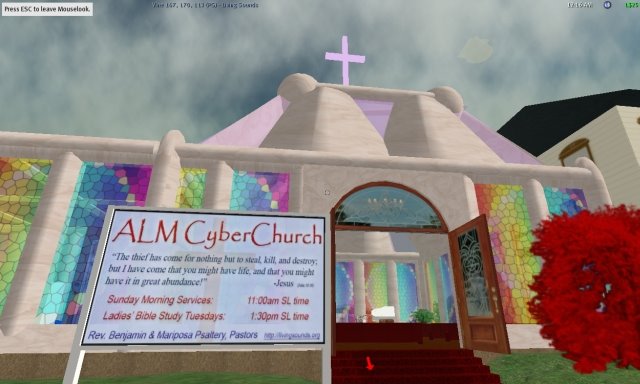
Last Sunday at 11 a.m. I went to a new church. It was in a large building with stained glass windows, there was a good sermon and great music, a few people wandered around, there was some whispering and giggling, people lifted their hands in worship or knelt in prayer. All pretty normal for a contemporary-style church.

However... in the congregation was a large pink rabbit, a fairie, a woman with large butterfly wings and a man who kept jumping 15 or 20 feet into the air.

What is this weird place and how did I get here?

Well, I had read about a cyberworld called Second Life, a beautifully designed online place that in an approximate way resembles reality. In this world people can construct buildings, wander around, fly (without an airplane), meet people and party - especially party. And, in wandering around, I discovered that probably a lot of the partying is way beyond my level of comfort.

Anyway, I wondered if there was a Christian presence in this "world." I poked around a bit and found that, indeed, there is, so last Sunday I rushed home from my own church and attended the ALM CyberChurch. It was really great! I was welcomed at the door; the sermon was excellent; there was a fellowship time in an adjoining room after church, and I felt I had been in God's presence.

I shared this experience with my real-world fellowship, and after discussing it I think we all concluded that - with some reservations - cyberchurch is a useful tool, but some folks were a bit afraid that it might draw people in so much that they don't attend a real-world church. And one man felt because you wear a cyberbody that people would find it harder to get to know the real you.

Here are my thoughts on these objections:

- I think that probably every advance in communications has raised the possibility that people will withdraw from face-to-face contact and rely on a communications tool for their spiritual life. I'll bet that in Gutenberg's day some people were afraid that printing and distributing the Bible would cause people to withdraw and take their spiritual nourishment from solitary reading. The same might be said of radio or television ministries. And, frankly, I think those people have a point. It is possible some people will prefer a cyberchurch to a real-world church.

I'd generally prefer people don't abandon real-world churches since a cyberchurch is only an approximation of real people getting together in real bodies to worship God - though in some cases I think a cyber-church would be better than attending a dead real-world church.

- On the question of people hiding behind masks in the cyberworld, I think that may be true, but I think it probably works both ways. While your real face and manerisms can reveal much of your inner self to a discerning observer, I wonder if people in the cyberworld, who can choose their own bodies, aren't in a way choosing a body they believe expresses their deeper self. Also, I'd ask if the anonymity of the cyber-world doesn't make people feel a bit safer to reveal their inner selves since nobody need know who they are in the real world.

I don't think a cyber-church is for everybody. In fact, I think my visits will probably be just occasional, but I can think of some examples where they'd be a huge blessing:

1. For people who are physically isolated.

2. For those with health problems who are unable to leave their homes.

3. As an outreach to various groups of people. You could have a traditional church, a contemporary one, a punk one, a goth one, churches for various ethnicities. Whatever. I think you will find the cost of building facilities in the cyber-world compares favorably with the cost of building in the real world.

4. As a meeting place for Christians in closed countries for whom it is dangerous - or too distant - to get together in person.

5. For a mid-week fellowship group.

6. As a place for fellowships begun in the real world to continue when people move away. For example, a college Christian group could maintain itself when everybody graduates.

For a good introduction to the concept of cyber churches, see the Living Sounds Web page by the pastor of the ALM CyberChurch. If you'd like to visit the church, you need to sign up for Second Life (a basic account is free) and download the special Second Life browser. When you've done that, you can go directly to the church by clicking here: secondlife://Vine/173/75 .

Saturday, January 14, 2006

Meaningless, Meaningless!

What a peculiar document is the biblical book of Ecclesiastes!

"'Meaningless, meaningless,' says the Teacher. 'Utterly meaningless! Everything is meaningless.'" The Teacher starts with that happy thought and winds up with it, yet sprinkled throughout the book are hints of something that is not at all meaningless.

One commentator suggested the author is taking on the persona (perhaps from his own experience) of the worldly person. I think the author is addressing the person who perhaps believes in God in a casual sort of way, but who is really just a materialist. For his discussion the Teacher adopts this worldly viewpoint and drives it unrelentingly to its logical and hopeless conclusion, but all the time dropping hints of something different and better.

Everything, he says, is going to crumble, and you yourself will die. And he proceeds along those lines in kind of a stream-of-consiousness fashion, poisonously juxtaposing comments about enjoying yourself with comments about your ultimately meaningless end. Or, in another case, saying a stillborn is better off than the living because the child has never experienced the pain of life on earth, while in another section saying that a live dog is better off than a dead lion. So, is it better to be dead or alive? The materialist could follow either line of logic, and the Teacher explores them both: Life's meaningless so I might as well just die, or, Life's all I've got so I should enjoy it while I can.

Mr. Cheerful he is not.

But then he goes and drops these little clues all over the place about the spiritual.

Without God, he says, "who can eat or find enjoyment." God has "set eternity in the hearts of men;" "everything God does will endure forever;" what God has done is "so that men will revere him;" "God will bring to judgement;" when man dies "he takes nothing from his labor that he can carry in his hand;" "I know it will go better with God-fearing men;" "Remember your Creator in the days of your youth;" on death "the spirit returns to God who gave it." Plus, there are lots of proverbs instructing people in how to live and, of course, there is the conclusion that men should keep God's commands and that God "will bring every deed into judgement."

His everyday proverbs on how to live and about doing good make no sense if the ultimate spiritual end is destruction. In that case, why do good unless it is convenient? His comment that God will judge makes no sense if that judgement is limited to this life. Listen to him: "Although a wicked man commits a hundred crimes and still lives a long time, I know that it will go better with God-fearing men." I mean, he's just admitted that sometimes the wicked live a long time, and if, after that, everything is over, judgement makes no sense at all. And why should men revere or remember God if spiritually - not just physically - the good and bad are both going to just be dead? Why would God put eternity in the hearts of men if there was nothing besides death? Just to mock us? And listen to this big hint - Hint? More like a flat-out statement - that the Teacher drops when he says that on death "the spirit returns to God who gave it." Wow! That's what lives on! The spirit.

But even on the spiritual level, the emphasis is on God, not on what we can do. What God does "will endure forever" while nothing we do for ourselves will last for long. It makes me think of the gospel, that Jesus did it all for us. It's not our work. It's his. We just need to trust in him so that when our spirits return to God, as Ecclesiastes says, we will stand in our spiritual selves before God with our sins cleansed and ready to experience the joy of that eternity that God has placed in our hearts.

Friday, December 30, 2005

The Philosophy of Elves and Dragons

I've been reading Christopher Paolini's Eldest, the second massive volume in his fantasy dragons-and-wizards trilogy begun with Eragon.

Reading their thoughts, I've come to the conclusion that despite their reputation for wisdom, you shouldn't put much stock in the philosophy of elves and dragons.

For example, on page 542 (hardback), Eragon is talking with the elf Oromis about elvish beliefs and the elf says, "I can tell you that in the millennia we elves have studied nature, we have never witnessed an instance where the rules that govern the world have been broken. That is, we have never seen a miracle. Many events have defied our ability to explain, but we are convinced that we failed because we are still woefully ignorant about the universe and not because a diety altered the workings of nature."

So, Oromis says the elves have witnessed events that "have defied our ability to explain," but nevertheless he is quite certain that those events are not miracles. And why couldn't those unexplained events be miracles?

Well, Oromis explains, the elves believe these events can't be miracles because the elves are still very ignorant of how the universe works. Hmmm... So elves don't believe a diety might work miracles because they're ignorant. Sorry, Oromis, the logic escapes me.

Then, to make it sillier, on the next page Oromis critisizes dwarfs for sometimes relying upon faith rather than reason. Methinks, Oromis, that if you want an example of faith, you should look in a mirror.

Oromis follows up by saying that if the gods exist, "have they been good custodians?" He then cites death, sickness, poverty, tyranny and other miseries.

But perhaps Oromis should consider the possibility that the inhabitants of the land may be at fault, and if the diety were to shackle the hands and feet and minds of people (and elves and dwarfs) to prevent them from committing evil, wouldn't Oromis complain that the diety is a tyrant, and that he enslaves his subjects? I think you might, Oromis.

Finally, Oromis says this athiestic view makes for "a better world" because "we are responsible for our own actions."

Oh, Oromis! The existance of God does not in the slightest take away our responsibility for our actions. If I steal from my employer does that mean I'm not responsible because my employer exists? Please don't talk nonsense, Oromis.

And then there's Eragon's dragon Saphira.

Eragon asks about her beliefs and Saphira replies, "Dragons have never believed in higher powers. Why should we when deer and other prey consider us to be a higher power?"

Uhh... I don't think Saphira had her coffee before replying. Let's just flip it around:

"Dragons have always believed in higher powers. Why shouldn't we when deer and other prey consider us to be a higher power?"

In other words, if Saphira is a higher power to the deer, why can't there be a higher power to Saphira?

Well, actually there is, and because writing the next 600-page book will no doubt take a while, author Christopher Paolini has plenty of time to get his subjects thinking straight. After all, he is a higher power to both Oromis and Saphira.

Sunday, October 16, 2005

Amish Entrepreneurs

I recently finished a book about how the Amish are leaving the farm because of the high cost of farmlan, and are starting businesses, and how, despite having less than a high school education, with little experience in business, with very little familiarity with technology and, of course, with limits on how they can use technology, they are doing better at it than a lot of non-Amish.

I was particularly struck by this statistic, at the start of chapter 12 of Amish Enterprise, by Donald Kraybill and Steven Nolt:
The story of Amish enterprise is largely a story of success, with only scattered tarnishes of failure. The default rate among small business in general is rather sobering, however. Nearly one-quarter of new American firms fold within two years, and some 63 percent close their doors within six years. During the 1980s, the rate of business failure nearly matched that of the Great Depression. The Amish launched more than 40 percent of their business ventures in the 1980s, but surprisingly, fewer than 5 percent of the Amish operations failed.

Wow! How do they do it?

Well, the authors don't lump all the reasons for their success in one place, so I'll miss some, but here are the reasons I remember:

- They start small, often in their homes or in outbuildings near their home.

- They start (and stay) simple, which keeps their costs down. Their culture frowns on luxuries and showing off, either for them personally or in their businesses. So their overhead is low. They're not big on splashy advertising, either, so they - to some extent - avoid one of the big costs of business - marketing. (I guess when you avoid self-promotion, you really have to rely on word of mouth.)

- They don't mind hard work (they're coming from a farming background, remember) and are willing to work long hours. What's interesting is that they don't regard work and family as separate and competing. They try (not always successfully) to make it a family activity. Mom and Dad run the business and the kids sweep up or do other chores.

- They are scrupulously honest. People like doing business with people they trust. Duh!

- They focus on high quality.

- They live simply, which means "cheaply," so they can charge less and still make a profit, and since they're not spending the money on indulgences, much of the money they make goes back into building their businesses.

- They help each other. If a business is having trouble, other Amish business people help out.

There are other things, like - well - just being Amish, which attracts customers because of its novelty, but the other things I can think of aren't transferable. If you pick up the book, by the way, it's a sociological study, not really a business book

This also reminds me of a most excellent business book, called Good to Great (Jim Collins), which I read a while ago. The one thing I remember without reviewing is what the author regards as the main reason why some companies that are just chugging along in their industry suddenly (apparently suddenly) break out of the pack and become excellent and remain so for at least 15 years. It's not what you think. It's not a great plan; it's not a brilliant CEO; it's not clever financing or deal making; it's not a revolutionary product, it's not "getting control of the purse strings" - it's a humble but determined CEO. He (or she) is determined to make the company successful, but figures he doesn't have the skills to do it himself, so he humbly hires the best possible people.

Sunday, August 28, 2005

Rockefeller's Philanthropy

A while ago I finished Titan, about the curious life of John D. Rockefeller, the founder of Standard Oil. Author Ron Chernow paints a picture of a contradictory and confusing but fascinating man, on the one side a hard-edged businessman who would cross over into illegal and immoral practices in his quest to succeed, but on the other side, a man who was actually quite generous and fair in his business practices and - far more interesting - a man who did amazing things with his money.

To say all I can on Rockefeller's positive side, he thought he was doing good - all the time. He thought cooperation in the oil industry was better than competition, so he tried to create a monopoly (he never quite succeeded). He actually overpaid for oil refineries and people sometimes started refineries just so Standard Oil would buy them - at inflated prices. Rockefeller was scrupulous in paying his debts, he never took on the trappings of nobility, as did some of his rich contemporaries, he always attended a simple Baptist church rather than moving up to some socially more acceptable church, and he tried to provide fuel to the world at cheap prices. And, as I mentioned, he gave generously, and when he did he seldom put his name on things ("Do not let your left hand know what your right hand is doing"), as did Andrew Carnegie.

On the negative side, if companies refused to deal with him he tried to drive them out of business, and in doing that he bribed public officials, tried (and failed) to block a competitor's pipeline by buying up land in its path, manipulated railroad prices, tactically undersold competitors to drive them out of business, and so forth. When the federal government wanted to regulate the new post-Civil War interstate commerce, Rockefeller had provided them with a handy list of what to legislate against.

How Rockefeller internally reconciled some of his practices to his Christian faith, I have no idea. Chernow certainly doesn't seem to have figured that out either.

Anyway, his philanthropies were amazing! There his Christianity shone.

Hookworm, once a debilitating problem in the Southern US states, is no longer a big problem. Why? Because Dr. Charles Stiles discovered it could be cured with some cheap medicine, and though his discovery was met with ridicule, Rockefeller believed, and basically paid to erradicate the problem. Rockefeller also started a public-private partnership to build thousands of schools across the South. He founded the Rockefeller Institute for Medical Research, the first medical research lab in the country, whose discoveries have saved thousands if not tens of thousands of lives. He was also the money behind the founding of the University of Chicago. Lots of other stuff, too.

What strikes me about his giving was that it was thoughtful and focused and for the most part the results of his giving could be fairly precisely measured.

It occurs to me that there are problems - such as the ones Rockefeller focused on - that can pretty much be solved once and for all, but there are other kinds of problems ("the poor you will have with you always") that are less amenable to a one-time solution. Necessary as it may be to give to charities addressing the less solvable problems, I suspect that the better an organization can define a problem and measure success in combating it, the easier it will be to persuade people to contribute.

Friday, August 19, 2005

Freddy the Pig

I enjoy reading to my son a bit every night. He especially likes talking-animal books, so we started off with C.S. Lewis's Narnia Chronicles (awesome!), then we read several of Brian Jacques' Redwall series (quite good). We tackled Robin Hood, King Arthur, Treasure Island, Tom Sawyer, Huckleberry Finn, Jeanne Duprau's City of Ember (excellent!) and The People of Sparks (very good), Eragon, Booth Tarkington's Penrod and Penrod and Sam (old and excellent but with some racist - though not intentionally malicious - overtones), Despereaux (okay), Time Stops for No Mouse (good) and The Sands of Time (good), by Michael Hoeye, Ken Oppel's Silverwing (okay), Sunwing (okay), and Firewing (weird), A Cricket in Times Square, and we just finished Lloyd Alexander's series, The Book of Three (first book, fair, others, excellent). But now, what to read? What to read?

Well, for some reason I thought of a series I loved as a child, Walter Brooks Freddy the Pig books. I thought these 26-or-so books were long out of print, but - as I discovered in perusing Amazon - they have been brought back. Happy day! All's right with the world! We picked up Freddy the Cowboy at the library and are reading and enjoying it. I'd have preferred to start with Freddy the Detective, but you start where you can.

Here's a silly snippet. Freddy the pig is asking Quik (a mouse) if Howard (another mouse) can come for a visit:
"I suppose it'll be all right," he [Quik] said. "If he doesn't eat us out of house and home. I never knew a field mouse yet who didn't eat like a pi- I mean, like a pinguin," he said hurriedly.

"What's a pinguin?" Jinx [the cat] asked, and Howard said: "I think he means a penguin. They're very greedy creatures, though seldom seen in this neighborhood."

Quik grinned at him gratefully, but Freddy said: "Penguin nothing! He started to say 'pig' and then couldn't change it to anything that made sense."

My son likes it and so do I, so I think we have reading material to keep us busy for a long time.

Anyway, help revive the Freddy books! There's probably one or two of them left in your public library. Try one, and if your kids (or you) like it, the whole set is available on Amazon.

Sunday, August 07, 2005

Gouge Out Your Eye

And if your right eye causes you to sin, pluck it out, and cast it from you: for it is better for you that one of your members should perish, than that your whole body should be cast into hell. And if your right hand causes you to sin, cut it off, and cast it from you: for it is better for you that one of your members should perish, than that your whole body should be cast into hell. - Matthew 5:29-30

When Jesus said, "If your right eye causes you to sin, pluck it out" he was - I've heard - speaking metaphorically. Well... maybe. But maybe not. Perhaps instead he was giving a literal reply to a bad excuse he'd heard once too often.

I think Jesus was responding to the whine - probably as prevalent then as it is now - that goes like this: "Well, I just can't help it, I've got a wandering eye." Or, in the case of the hand, "I can't help it. I just have sticky fingers."

Okay, Jesus says, sighing a bit, I imagine, if it is really your eye that is dragging you into sin, then you really better gouge it out.

I can hear the whiner responding, "Uhhh, well, um, okay. I didn't literally mean my eye causes me to sin. My eye only does what I tell it to do."

Precisely!

And this, I think, is just what Jesus is trying to communicate. Don't blame your hand or eye. The sin comes from your heart, and you know it, and that is what needs to change.

Saturday, July 30, 2005

Communism That Works

I've never been a communist, never wanted to be one, and never thought communism worked. But on that last point, while I'm confident I'm generally right, there's a group that proves me partially wrong.

I just finished a book on quite an interesting group of people, called the Hutterites, an Anabaptist Protestant group who date back to the Reformation. The Hutterites came to the conclusion that they should live communally, and have been doing so almost without interruption since the 1500s. Because of persecution they left Moravia (in what is now the Czech Republic) for the Ukraine, then moved to North America in the 1870s, and now they live in Alberta, Manitoba and Saskatchewan in Canada and in Montana and the Dakotas in the United States.

That a group has managed to live for such a long time communally strikes me as quite amazing since so many other communal groups have utterly failed. Here are a few of my thoughts about why they have survived:

  • Far from being atheistic - as was Russian communism - the Hutterites are deeply religious. They believe their reward is in heaven, and so they don't feel much need to "succeed" - in a financial sense - here on earth.

  • They're under no silly illusion that communal living is a utopia. They believe people have sinful tendencies, even in their "colonies," as they call their communes, so nobody is disillusioned when someone does something unchristian.

  • Their colonies are relatively small, numbering about 80 to 150. It seems to me that a smaller group like this can maintain a family feeling whereas a larger group cannot. In fact, the book, Hutterite Society (by John A Hostetler), makes this point, that the larger groups become prone to factions. To deal with that, the Hutterites intentionally split the colonies and create daughter colonies when they become too big.

  • They maintain a cultural distance from their neighbors. Their colonies are in isolated locations, the people don't mix much with non-Hutterites, they dress differently, they speak German as a first language (though they also learn English). I suspect this cultural distance makes colony members feel less at home outside the colony and thus makes it harder for colony members to leave, but at the same time I'd guess it probably annoys their neighbors, whom I suspect may feel looked-down-upon by the Hutterites.

  • They strongly teach their traditions but de-emphasize higher education, which they feel isn't useful for farm life and leads to independent thinking (they're probably right) and thus to a breakdown of communal life.

    Although the Hutterites have not only survived, but grown dramatically in numbers, one thing that strikes me about their growth is that it is almost entirely by having children. Very few non-Hutterites ever become Hutterites.

    I suspect this is because of the cultural distance I mentioned. I have a theory that for churches to grow by attracting new members, there is a sweet spot in cultural positioning. If the church is too far removed from society (as are the Hutterites and the Amish), growth by conversion drops to just about nothing. On the other hand, churches that simply reflect society have nothing to offer the seeker. If the church is just the same as the everyday world, why bother going?

    I think that sweet spot for most churches is just to obey Christ. For me, that is adequately removed from everyday society. If you go a lot further, into cultural isolation, as do the Hutterites and Amish, I think you can minimize people defecting from Christ to the world, but the cost will be to minimize defections from the world to Christ.